Pancakeswap liquidity pools create positions whose fee and withdrawal rules depend on pool design
Last updated:
Pancakeswap liquidity pools can accept paired assets. Some pool types support single-token deposits, and a concentrated position can also require only one asset when its range sits entirely to one side of the current price. The deposit produces a position record: fungible LP tokens in V2, a non-fungible position in V3 or an Infinity position shaped by its pool type. That record controls the share that can earn swap fees and the assets returned when liquidity is removed. Fees, range activity and withdrawal treatment differ by version, pool type and configured settings.
Pool design determines the deposit record
Fee earning and collection can depend on the pool type, fee setting and any active hook. Confirm those details before committing assets.
V2 pool shares
V2 deposits create fungible LP tokens representing a proportional share of the entire pool. The pool's ratio determines how much of each asset a deposit can accept. Swap fees retained by the pool increase the value represented by its LP tokens. Removing liquidity redeems some or all of those tokens for the corresponding share of both pool assets at the ratio that exists when the withdrawal executes.
V3 configured positions
V3 records each position as a transferable NFT with its own token pair, fee tier, liquidity amount and price range. The required asset ratio follows the selected range and current price, so the deposit doesn't always have equal values on both sides. A range entirely above or below the current price can produce a single-asset position. Moving to another range or fee tier requires a separately configured position.
Infinity and StableSwap layouts
Infinity supports concentrated-liquidity, liquidity-book and StableSwap pools. A concentrated-liquidity automated market maker, or CLAMM, assigns liquidity to a chosen price interval. A liquidity-book automated market maker, or LBAMM, distributes it among discrete price bins. Classic and Infinity StableSwap positions use fungible ERC-20 LP tokens and a stable invariant for assets expected to trade near a peg. Infinity StableSwap keeps liquidity active across the full curve and supports single-token deposits. Infinity pools can also use hooks that change fee logic or behavior around liquidity actions. Review the displayed pool type, active hook and live settings before depositing.
Position records and withdrawal treatment
A position record is the claim on deposited assets, not a disposable receipt. Its design tells the interface how to calculate ownership, accrued value and the withdrawal route.
| Design | Position record | Withdrawal treatment |
|---|---|---|
| V2 | Fungible LP tokens representing a proportional pool share | Redeeming LP tokens returns the corresponding share of both pool assets |
| V3 | Transferable NFT containing the pair, fee tier and selected range | Principal can be removed partly or fully, while accrued fees are collected separately |
| Infinity LBAMM | Fungible ERC-20 liquidity tokens for the selected price bins | Liquidity and fees accumulated in active bins are included in the withdrawn amounts |
Possession matters because LP tokens and position NFTs can convey control over the underlying claim. Sending one to another wallet isn't the same as moving a harmless display token. The receiving address may gain the ability to manage or withdraw the represented liquidity, subject to the position's contract rules.
Range width controls active V3 liquidity
A V3 price range sets the interval where the position contributes assets to trades. A V3 position earns swap fees only while the market price sits inside its selected range. A narrower range concentrates the same liquidity across less price space, which can increase its relative share of active liquidity. It also takes a smaller price move to leave that interval.
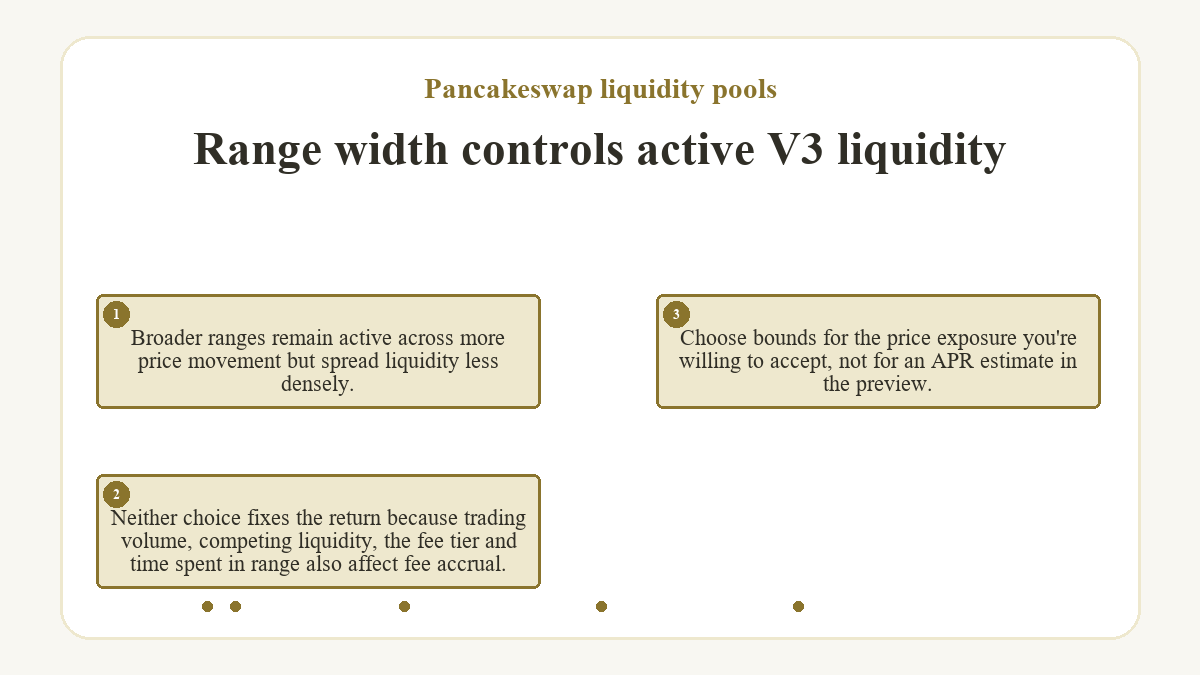
Broader ranges remain active across more price movement but spread liquidity less densely. Neither choice fixes the return because trading volume, competing liquidity, the fee tier and time spent in range also affect fee accrual. Choose bounds for the price exposure you're willing to accept, not for an APR estimate in the preview.
What changes when a V3 position leaves its range?
An out-of-range V3 position stops supplying active liquidity and stops accruing swap fees. Its underlying composition shifts fully toward one asset, with the asset determined by the direction in which price crossed the range. The position still exists, and its ownership record doesn't disappear merely because its status changes.
If the market price returns inside the selected interval, the position can become active again without a new deposit. Withdrawing while it remains outside the range returns the resulting single-sided composition. That may differ sharply from the pair originally supplied, so check the range status before withdrawing as well as before depositing.
Fee accrual follows the position design
Fee handling changes with the pool architecture. V3 trading fees accrue outside the principal liquidity and must be collected rather than compounding automatically. Collecting them doesn't require removal of the position's principal. Each collection is an on-chain action, however, so its network cost can affect whether a small accrued balance is worth claiming immediately.
V2 routes trading fees back into the pool, which increases the pool assets represented by outstanding LP tokens. Infinity LBAMM pools add fees to the active bins instead of presenting a separate collection balance. In every design, the gross amount depends on trades that use the relevant liquidity and the fee rules attached to that pool.
Farm incentives remain separate from swap fees. A position can earn pool fees without qualifying for a farm, while an eligible farm can apply its own reward calculation, activity requirements and collection process. A displayed APR is an estimate based on changing inputs, not a fixed withdrawal amount.
Impermanent loss changes the value of an exit
Impermanent loss compares a liquidity position with simply holding the same starting assets outside the pool. As their relative price changes, the automated market maker adjusts the position's composition. A withdrawal can therefore return more of one asset and less of the other than the original deposit. Concentrated ranges can make that change more pronounced when price travels through and beyond the selected interval.
The word impermanent describes a comparison that can change before exit; it doesn't promise that the gap will reverse.
Accrued fees may offset part or all of that difference, but they don't guarantee a profitable position. The relevant comparison includes the returned assets, collected fees, any separate farming rewards and network costs. Measuring only the fee balance leaves out the main change in principal composition.
Deposit readiness before wallet approval
Confirm the exact assets, network and pool configuration before signing a deposit request. A matching ticker alone doesn't establish that each token is the intended contract or mint.
Asset identity and spendable balances
Asset identity should match the selected network and the identifiers shown for the pool. The connected account needs the deposit assets in spendable form, plus the network's fee asset for every required transaction. Funds held on another chain, in another account or inside a different position can't satisfy the deposit until they are moved through the appropriate mechanism.
Allowances and wallet requests
Allowances may be required before an EVM contract can spend an ERC-20 token. Each input can produce its own approval request, followed by the liquidity transaction. An approval authorizes spending under its stated limit; it doesn't create the position. Review the spender, token and amount in the wallet instead of treating every request as the final deposit.
Pool settings at the commitment point
The final preview should identify the pair, pool version, fee tier where applicable and price range for concentrated liquidity. It should also show the amounts being committed. If a Zap or similar route converts assets before creating the position, that conversion introduces price impact and slippage exposure. Those details need review before the wallet broadcasts the transaction.
Completion evidence after a deposit
Position confirmation requires a successful transaction record on the selected network and a matching position under the same wallet account. V2 completion usually appears as an LP token balance. V3 completion produces a position identifier and NFT tied to its configuration, while Infinity uses the record appropriate to its pool type. If the interface hasn't updated, first recheck the account, network and transaction status. Don't submit the deposit again while the original transaction is still pending. A failed transaction can be retried after its specific cause is corrected.
Partial removals and complete exits
Liquidity removal can reduce a position or empty it. The requested percentage and the position's state determine what remains after confirmation.
Removing part of the principal
A partial V2 withdrawal redeems only the selected LP-token share. In V3, removing some liquidity leaves the original NFT and price range in place with a smaller liquidity amount. Future fee exposure then applies only to the remaining active liquidity. The previewed token amounts reflect the pool state when the removal is prepared and may change before execution within the transaction's limits.
Emptying or closing a position
A full withdrawal removes all principal represented by the selected share. That action isn't always identical to deleting, burning or hiding an empty position record. The available close behavior depends on the version and interface path. Confirm both the received wallet balances and the remaining liquidity amount before assuming the position has been fully reconciled.
Fees included at exit
Fee treatment at withdrawal follows the design selected at deposit. V3 can require a separate collection action for accrued fees, even when principal is removed. In an Infinity LBAMM pool, earned fees are included in the token amounts withdrawn from active bins rather than shown as a separate fee balance. A V2 redemption already reflects fees retained in the pool through the LP token's proportional claim.
Farm status alongside pool liquidity
Farming can add another state to a liquidity position without changing how the underlying pool computes swap fees. Some farm designs require a position to be staked, while eligible Infinity positions may accrue incentives without a separate staking transaction. Reward eligibility, harvest timing and active-liquidity conditions belong to the specific farm rather than every pool with the same asset pair.
Before reducing or closing liquidity, inspect whether the position is attached to a farm and whether the action will harvest, unstake or leave rewards pending. Pool withdrawal and farm exit may be combined in one interface path or require distinct actions. The transaction preview should show which state is changing.
Withdrawal reconciliation in the wallet
Confirm a successful transaction, then verify that the returned assets appear under the correct account and network. Compare the receipt with the decrease in LP tokens or position liquidity. Then match the received token identifiers and amounts with the removal record. A pending request, a refreshed interface or a zeroed form doesn't prove that settlement occurred.
If an expected balance is missing, check the wallet's network, account and token-display settings before repeating the removal. A confirmed receipt can distinguish an interface display problem from a failed transaction. When only part of the position was removed, its remaining liquidity and range should still appear. Only then can the removed share be treated as available wallet assets.
Key questions about Pancakeswap liquidity pools
Does holding a V3 position NFT mean the liquidity is earning fees?
No. The NFT proves ownership of a configured V3 position, but fee earning depends on the market price being inside its selected range and trades using that liquidity. An empty or out-of-range position can still have an NFT. Inspect the position's liquidity amount, range status and uncollected fees separately. It can become active again if price moves back inside the range.
What rights move when an LP token or position NFT is transferred?
The recipient can gain control over the liquidity claim represented by the transferred asset. V2 LP tokens represent a proportional pool share, while a V3 NFT represents its configured liquidity and associated fee claim. A transfer should therefore be treated like moving an asset with withdrawal rights. The exact position, network and receiving address should be checked before signing.
How should token identity be checked before a deposit?
Match each token's contract or mint identifier and network with the intended pool. A ticker and logo aren't enough because unrelated tokens can use the same symbol. The wallet account must hold the verified assets on that network, along with enough of its fee asset for every required transaction. This check also prevents selecting a similarly named pool by mistake.
Are the token amounts in a deposit preview final?
The preview describes the position under the pool state available when it was prepared. Prices and liquidity can change before the transaction executes, which may alter the amounts actually deposited within the permitted limits. A route that rebalances inputs can also add swap price impact. Review any minimum amounts, slippage setting and conversion details before approving the wallet request.
When does adding funds require a new V3 position?
A new V3 position is needed when the intended fee tier or price range differs from the existing NFT's configuration. Adding liquidity to an existing position keeps that position's pair, fee tier and range. Increasing the amount alone doesn't require different settings when the interface and deployed contracts support adding to that position. The updated liquidity should appear under the same position identifier after confirmation.
Must V3 liquidity be removed before accrued fees are collected?
No. V3 fees can be collected from the position without removing its principal liquidity. Collection is a separate on-chain action and requires a network fee, so the cost may matter when the accrued balance is small. Collecting fees also doesn't change an out-of-range position into an active one. Range activity still depends on the current market price.
Does removing pool liquidity also swap the returned assets?
A standard removal returns the assets represented by the position at its current composition; it doesn't inherently sell them into another asset. A Zap or one-token exit can add a conversion when that option is selected. Such a route has its own price impact and slippage conditions. The removal preview should state the tokens being returned and any conversion before the wallet signs.
What should I check when a known position is missing from the interface?
Check the connected account, selected network, pool-version filter and transaction record first. A V2 position may appear as an LP token balance, while a V3 position is tied to its NFT and position identifier. Interface indexing can lag behind a confirmed transaction. Don't repeat a deposit or withdrawal until the original transaction's status and the on-chain position record are clear.