PancakeSwap: First Swap Setup, Quote Review and Confirmation
Last updated:
A first PancakeSwap quote can lead to a wallet-broadcast transaction or, when PancakeSwap X is selected, a signed order that a filler settles on-chain. Before signing, match the network and token identifier, keep enough of the network's fee asset for any required on-chain approval or AMM transaction and inspect the expected output, route, price impact and minimum received. Some tokens also require a separate approval. Treat the swap as complete only after the transaction succeeds or the signed order is filled and the output balance is visible in the same wallet account.
Key takeaway: A first swap is finished only when its transaction receipt succeeds or its signed order is filled and the output balance can be reconciled with that record.
Wallet, network and token readiness
A first swap needs a compatible wallet and a spendable input token on the selected network. When the route requires an on-chain approval or a wallet-broadcast transaction, the same account also needs enough of that network's fee asset.
The connected account
The connected account determines which balances PancakeSwap can read and which wallet receives the signature request. Compare the shortened address in the interface with the account selected in the wallet. A connection lets the interface request information and signatures, but it doesn't require a recovery phrase or private key.
Spendable input
The input balance must exist on the network selected for the swap. An asset with the same ticker on another chain isn't available to this transaction. Funds held by another account or deposited in a liquidity position aren't part of the spendable balance shown for this swap.
Network fee balance
For an on-chain approval or AMM swap, the wallet pays the network charge with that chain's fee asset, which can differ from the token being exchanged. Leave enough to cover every required on-chain action. A PancakeSwap X order submission doesn't require the reader's gas token, although a preceding on-chain approval does.
Token identity
The network-specific token identifier distinguishes the intended asset from unrelated tokens that reuse its name or ticker. Confirm that identifier before importing an unfamiliar token or granting it permission. The output token also needs an active route with sufficient liquidity; a visible token entry alone doesn't establish that a usable swap exists.
What must the quote show before you sign?
The quote should identify the input amount, estimated output, minimum received, route, price impact and trading fee. If the route prepares an on-chain transaction, the wallet also presents its network charge. A PancakeSwap X order instead uses a signature, though an earlier token approval may have its own charge.
The route can use one pool, several hops, a split across liquidity sources or, when eligible, a PancakeSwap X order sent to off-chain fillers for on-chain settlement. Route details matter because each path can change the trading fee and expected output. A direct-looking token pair doesn't guarantee that execution uses a single pool.
The minimum received is the lower boundary accepted by the prepared transaction. It reflects the quote and its slippage setting. If execution can't satisfy that boundary, an AMM swap should revert rather than settle below it, although the attempted transaction may still consume a network fee. A PancakeSwap X order can instead remain unfilled and fail; submitting that order uses a signature rather than a wallet-broadcast transaction.
For a pool route, price impact estimates how the proposed trade changes the pool price during execution. A larger trade relative to available liquidity can worsen that impact. Raising slippage tolerance doesn't create liquidity or improve the price; it only widens the range of outcomes that the transaction may accept.
A quote can update while it remains unsigned because pool balances, routes and market conditions change on-chain. Recheck every displayed value after a refresh or route change. The figures reviewed in the interface should still match the action presented for confirmation.
Approval and the commitment point
On networks that use token allowances, the input token may require permission before a router can spend it. Depending on the wallet and route, permission may appear as a signed authorization or an on-chain approval. Read the wallet action carefully because an approval authorizes spending but doesn't perform the swap.
An on-chain approval has its own transaction record. Once that record succeeds, the interface can prepare the swap request, subject to the authorized amount and other permission terms. A completed approval with an unchanged input-token balance is therefore a ready state, not evidence that the exchange failed.
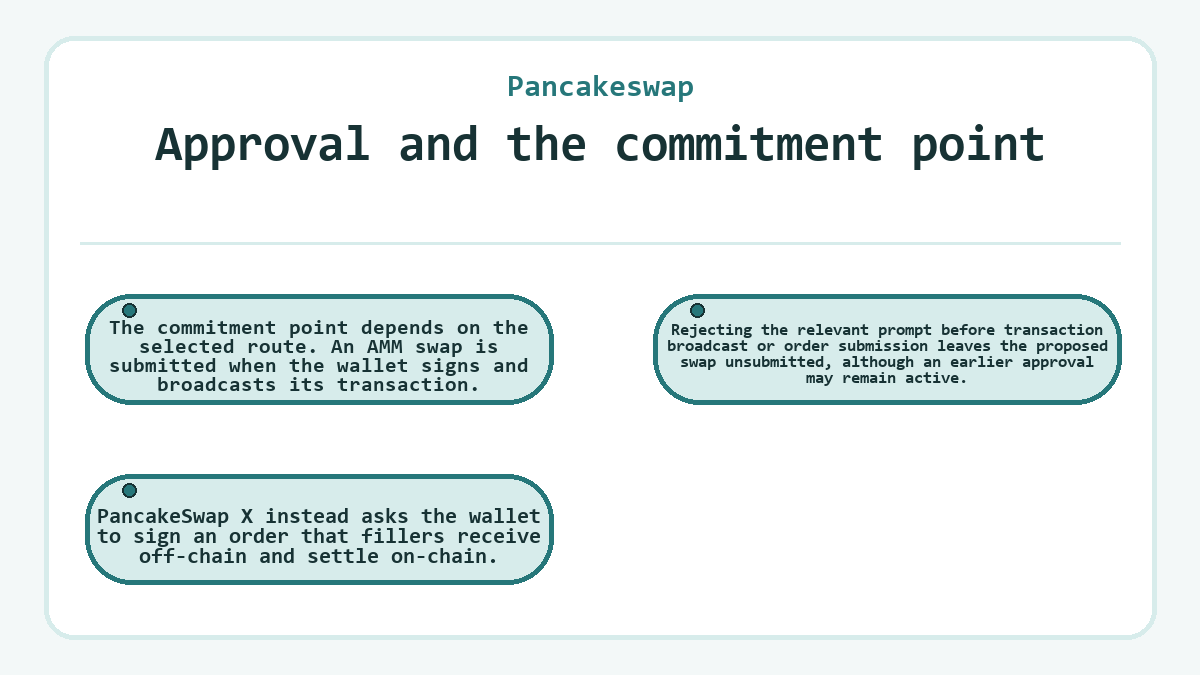
The commitment point depends on the selected route. An AMM swap is submitted when the wallet signs and broadcasts its transaction. PancakeSwap X instead asks the wallet to sign an order that fillers receive off-chain and settle on-chain. Rejecting the relevant prompt before transaction broadcast or order submission leaves the proposed swap unsubmitted, although an earlier approval may remain active.
What does a pending swap mean?
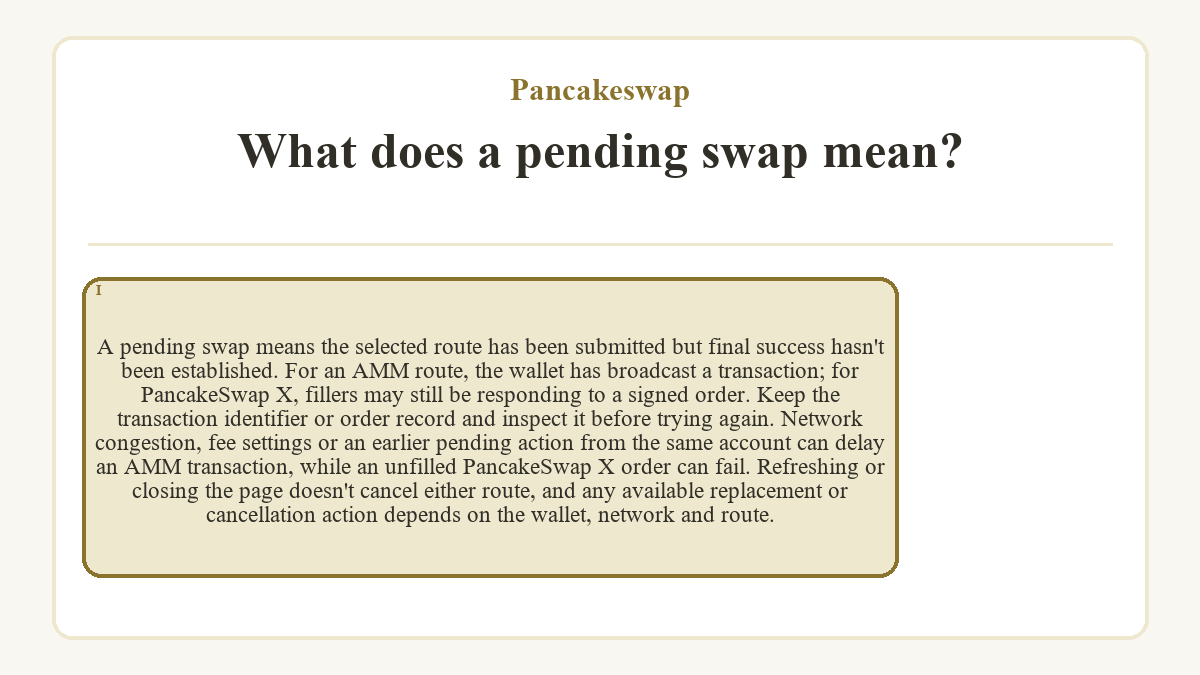
A pending swap means the selected route has been submitted but final success hasn't been established. For an AMM route, the wallet has broadcast a transaction; for PancakeSwap X, fillers may still be responding to a signed order. Keep the transaction identifier or order record and inspect it before trying again. Network congestion, fee settings or an earlier pending action from the same account can delay an AMM transaction, while an unfilled PancakeSwap X order can fail. Refreshing or closing the page doesn't cancel either route, and any available replacement or cancellation action depends on the wallet, network and route.
Completion evidence on the selected chain
For an AMM swap, a successful transaction receipt is the primary completion record. It ties the swap to the connected account and selected network. For PancakeSwap X, check that the order status shows a successful fill and confirm the output balance after on-chain settlement. Any interface success message should agree with the corresponding settlement record rather than replace it.
Next, reconcile the output balance with the successful transaction receipt or filled order record. A wallet can hide an unfamiliar token until its network-specific identifier is added to the asset list, and a cached balance can update later than the settlement record. Check the same account and network before assuming the output is missing. A failed transaction or failed order means the exchange didn't settle, even if a preceding approval succeeded.
When should you stop before confirming?
Stop when the wallet prompt doesn't match the network, account, amount or action that you reviewed. Rejecting a mismatched request leaves it unsubmitted. Confirming an AMM transaction broadcasts an on-chain action, while signing and submitting a PancakeSwap X order authorizes fillers to settle it.
Decision checklist at the signing boundary
Use the wallet prompt to compare the prepared action with the quote immediately before commitment:
- The connected account and selected network still match.
- The input token identifier and amount are the intended values.
- Any permission prompt matches the intended token, spender and allowance.
- The minimum received remains acceptable after any quote refresh.
- Any displayed network charge leaves enough of the fee asset for submission.
When every item matches, confirm the intended action and retain its transaction or order record. If the route disappears or the quote changes beyond the accepted boundary, reject the prompt and request a fresh quote. An approval that already succeeded remains a separate permission and shouldn't be mistaken for a completed swap.
Reconciliation when the balance looks unchanged
An unchanged balance calls for record matching, not an immediate retry. Check whether the wallet shows a transaction identifier or order record, whether that record is pending, successful or failed and whether the displayed account and network are correct. A successful approval followed by no swap record means the spending permission changed but the exchange wasn't submitted. A successful swap record with a hidden output token points instead to wallet display or token-list handling.
A clean exit from the first session
The session can end after the settlement record, output balance and remaining fee balance agree with the intended action. Save the transaction identifier or order record if you'll need to revisit the result. Disconnecting the wallet can close the interface session, but it doesn't reverse a confirmed swap or cancel a transaction or order that is still pending.
Disconnecting a wallet from the interface does not revoke an on-chain token allowance. Review any permission granted during the first swap and reduce or revoke it through a compatible approval-management action if it is no longer wanted. That separate change may require another network fee. The final check leaves a clear swap record and an accurate view of any permission that remains.
Helpful answers about Pancakeswap
Does connecting a wallet let PancakeSwap spend tokens without another request?
No, a standard wallet connection doesn't by itself authorize token spending. It lets the interface read the public account and prepare requests for that account. A token allowance, signed permission, swap transaction or signed order requires a separate wallet action. Read each prompt because the consequences differ: connecting establishes a session, approval grants defined spending permission and swap confirmation submits the exchange.
Should I approve only the amount planned for the first swap?
A limited approval can restrict the approved spender to the amount authorized for the planned transaction. Some wallets or routes may propose a larger allowance, so inspect the amount and spender before signing. If the remaining allowance is later too small, another approval may be required. Reducing exposure can therefore add a future permission step and its associated network charge.
Is the network charge paid from the token being swapped?
For an AMM swap or on-chain approval, the wallet normally pays the network charge with the selected chain's fee asset, not the quoted output token. A PancakeSwap X order submission doesn't require a gas token, although a preceding on-chain approval does. If the fee asset is also the input to an AMM swap, don't commit its entire balance because the transaction still needs enough for execution.
What happens after I reject the swap request in my wallet?
Rejecting the wallet request prevents that proposed AMM transaction or PancakeSwap X order from being submitted. No corresponding transaction or order record should exist for the rejected request. Any earlier approval is separate and can remain valid, so rejecting the swap doesn't automatically remove token permission. Return to the interface, obtain a current quote and review the next prompt before deciding whether to continue.
When is a fresh quote needed after token approval?
A fresh quote is needed when the interface refreshes the route or any material value changes after approval. Approval doesn't reserve a price, pool balance or expected output. Review the route, trading fee, price impact and minimum received again before signing the swap. If the new terms no longer fit the intended boundary, reject the request rather than relying on the earlier quote.
Could a first swap produce more than one wallet request?
Yes, the first attempt for an allowance-based token can involve one request for spending permission and another for the swap. An on-chain approval and the swap may each create a transaction record and network charge. The second request may be an AMM swap transaction or, on an eligible PancakeSwap X route, an off-chain order signature. A separate signed permission can add another route-specific prompt. Identify each request by its stated action instead of assuming the first confirmation exchanges the tokens.
Does refreshing the page cancel a transaction that is already pending?
No, refreshing or closing the page doesn't cancel a transaction that the wallet has already broadcast. Reopen the wallet's activity and inspect the original transaction identifier on the selected network. Use only the wallet's supported replacement or cancellation controls if action is necessary. Submitting another swap without checking the first can make the account history harder to reconcile.
Where should I check a swap that never appeared in the app's history?
Start with the connected wallet's activity for the same account and network if the quote used an AMM route. Its transaction identifier shows whether the swap is pending, successful, replaced or failed. If no identifier exists, the AMM request may never have been broadcast. If the route used PancakeSwap X, check the interface's order record because the wallet signs the order and a filler submits the settlement transaction. In either branch, distinguish the swap from a preceding approval, which can succeed without exchanging or receiving tokens.