Pancakeswap: How Token Swaps, Yield and Transaction Costs Work
Last updated:
Pancakeswap lets a connected wallet swap tokens through on-chain liquidity, provide assets to pools and pursue yield through eligible farming positions. A swap quote combines an execution route with the expected output, price impact, pool fees and a minimum received amount. The wallet then shows the network charge and requests a signature. Completion means the transaction has been confirmed on the selected chain and the resulting token balance or position is visible there. Returns from liquidity or farming are separate from swap execution. They depend on pool activity, reward rules and market movement. Checking the live route before signing matters because pool versions and configurations can change the available action and cost.
The short version: A reliable swap starts with the route, minimum received amount and network fee shown before the wallet signs.
From wallet readiness to a settled swap
A token swap begins on the network where the input asset already exists. The connected wallet needs the input token plus enough of that chain's native currency to pay transaction fees. Selecting the output token produces a route and quote, but it doesn't move funds until the wallet authorizes the required transactions.
Quote readiness
Wallet readiness includes checking the network, on-chain token identifiers, input amount and expected output. The route may use one pool or several hops, and each hop can affect the fee and final amount. On networks that use token allowances, an approval may be required before the swap contract can spend that asset. Approval and swapping can therefore appear as separate wallet requests.
Signature and settlement
Transaction confirmation should show the intended network, spending action and estimated network charge. After submission, the swap remains pending until the network confirms success or failure, or the transaction is dropped, replaced or expires. A transaction record showing success and the resulting output balance provide completion evidence. If execution fails, the token exchange doesn't occur, although the network may still charge for the computation already processed.
What determines the final swap cost?
The final swap cost comes from the route's pool fees, network charges and price movement between quoting and execution. These components have different causes, so a low pool fee doesn't necessarily produce the best final output.
Pool fees and routing
Pool fees follow the liquidity sources selected for the trade. A multihop route can apply a fee at each pool it crosses, while a split route can divide the input among several sources. The useful comparison is the quoted output after route fees, not one fee tier viewed alone.
Network charges and quote protection
Network fees pay for transaction processing and normally use the chain's native asset. Price impact estimates how the proposed trade changes the pool price. Slippage tolerance sets the acceptable movement between quote and execution, while the minimum received amount defines the output boundary enforced by the transaction.
Common pool versions and fee behavior
Pool versions use different fee settings and liquidity records. The route details identify which model applies before confirmation.
| Pool version | Swap fee setting | Liquidity record | Governing condition |
|---|---|---|---|
| V2 exchange | Fixed 0.25% per pool hop | Fungible LP tokens | The fee is fixed, but execution still follows pool reserves |
| EVM V3 | 0.01%, 0.05%, 0.25% or 1% | Position NFT with a selected range | Only in-range liquidity participates and earns fees |
| Infinity | Static at creation or dynamic through a hook | CLAMM position NFT or fungible LBAMM bin tokens | The fee type can't change after pool initialization |
Liquidity positions and their trade-offs
A liquidity position supplies assets that swaps can draw from. In return, the position may collect part of the trading fees generated by its active liquidity. Its value can still diverge from simply holding the deposited tokens because trades continuously change the asset mix.
Concentrated V3 ranges
V3 lets a provider select the price range in which the deposited liquidity remains active. A narrower range concentrates capital near chosen prices, but it also needs closer management. A V3 position earns swap fees only while its selected range contains the current pool price. Outside that range, the position stops serving trades and may become composed mainly of one token.
Infinity pool designs
Infinity includes concentrated liquidity pools and liquidity book pools built from discrete price bins. Concentrated positions use ranges, while bin-based positions place liquidity at specific price levels. Hooks can add pool-specific logic such as dynamic fees. That flexibility makes the live configuration part of the position's risk, because two pools for similar assets may behave differently.
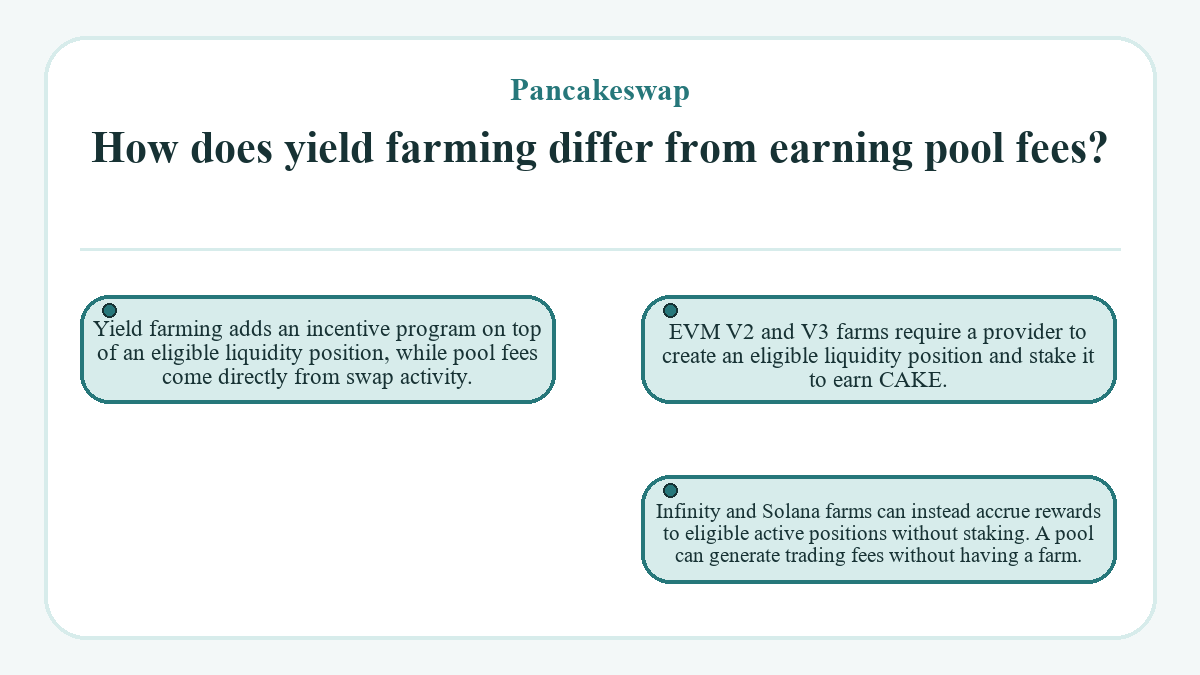
How does yield farming differ from earning pool fees?
Yield farming adds an incentive program on top of an eligible liquidity position, while pool fees come directly from swap activity. EVM V2 and V3 farms require a provider to create an eligible liquidity position and stake it to earn CAKE. Infinity and Solana farms can instead accrue rewards to eligible active positions without staking. A pool can generate trading fees without having a farm.
Displayed farm and fee APR estimates can change as reward emissions, active or staked liquidity, trading volume and token values change. Farming also retains the underlying position's exposure to price movement and impermanent loss. Harvesting, staking or adjusting a position can require another transaction fee. Other earning products may use a single staked asset and follow separate lock, withdrawal and reward conditions.
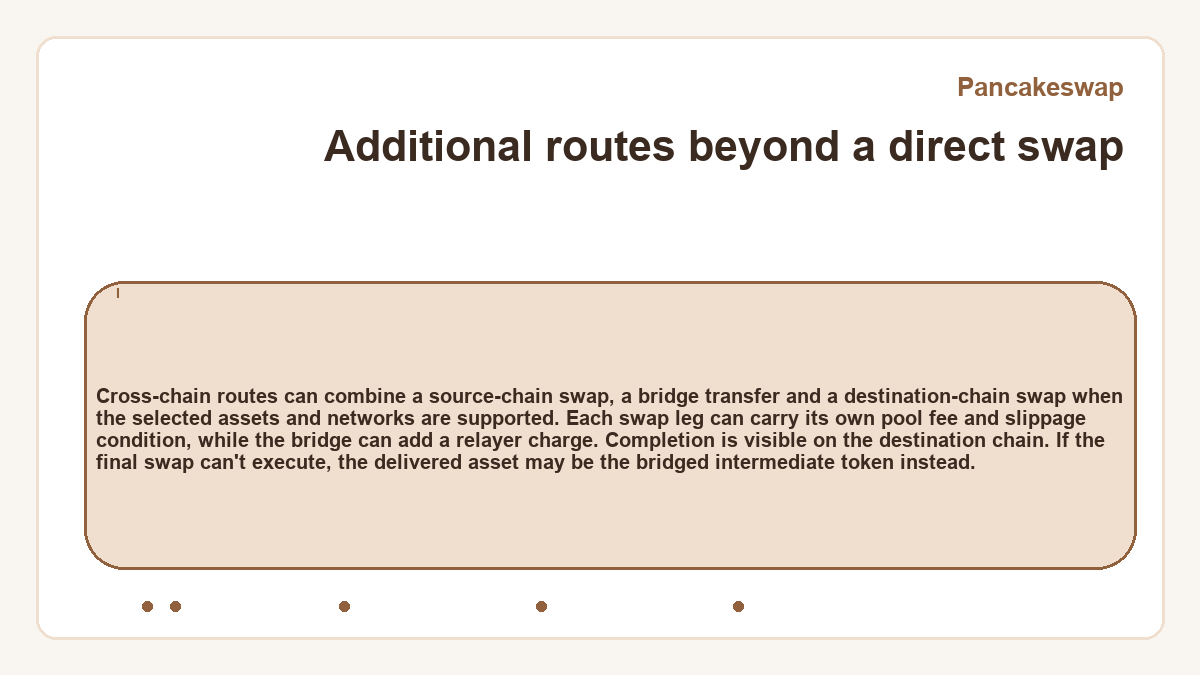
Additional routes beyond a direct swap
Cross-chain routes can combine a source-chain swap, a bridge transfer and a destination-chain swap when the selected assets and networks are supported. Each swap leg can carry its own pool fee and slippage condition, while the bridge can add a relayer charge. Completion is visible on the destination chain. If the final swap can't execute, the delivered asset may be the bridged intermediate token instead.
Limit orders handle a different task. They place the input as one-sided liquidity around a target price instead of swapping immediately at the current pool price. Reaching the target doesn't guarantee a complete fill because swaps must consume all of that deposited liquidity. Direct swaps, limit orders and bridge routes therefore have different completion states and cost inputs.
Permissions, contracts and transaction risk
On networks that use token allowances, permissions determine which contract may spend a wallet's assets and how much it may spend. An unlimited approval remains available to that spender until it is replaced or revoked. Reducing an allowance narrows that exposure, although changing it requires a network transaction. An approval authorizes a named spender for a specific token, not every asset in the wallet.
Matching symbols can belong to different on-chain assets, so the asset identifier matters more than the displayed ticker. Pool availability also doesn't establish that a token's code, transfer rules or administration are safe. Fee-on-transfer logic, sale restrictions and mutable contract controls can change what a wallet receives or whether it can trade back. Hooks introduce another layer of pool-specific code in Infinity.
Choosing when another approach fits better
A direct swap fits an immediate exchange when sufficient liquidity produces an acceptable minimum output. A limit order fits a target price with no fixed completion time. A separate bridge can suit moving the same supported asset between chains when no token conversion is needed.
A custodial venue may be more suitable when the required task involves fiat deposits, account-based reporting or supported recovery procedures. Liquidity provision fits assets that a provider is prepared to manage as a changing pair rather than a fixed balance. No route removes the limits imposed by available liquidity, network capacity and the selected contract's rules.
Before you start with Pancakeswap
Do I need a centralized exchange account to use Pancakeswap?
No, Pancakeswap swaps use a compatible self-custody wallet rather than a registered exchange account. The wallet must already hold the input asset and enough native currency for network fees on the selected chain. Acquiring crypto with fiat is a separate step and may involve an exchange, payment provider or another transfer source with its own account requirements.
Does switching the network in my wallet move tokens between chains?
No, changing the selected wallet network only changes which blockchain the wallet displays and interacts with. It doesn't transfer an asset or create a copy on another chain. Moving value across networks requires a supported bridge or cross-chain route. The destination balance appears only after that transfer reaches its recorded completion state.
What does insufficient liquidity mean during a token swap?
Insufficient liquidity means the available route can't supply the requested output under its current reserves and execution limits. The quote may disappear, show excessive price impact or reject the proposed amount. Reducing the input can sometimes produce a valid route, but increasing slippage doesn't create liquidity and can expose the trade to a much worse execution price.
Is the quoted token amount guaranteed until a swap confirms?
No, a quote reflects pool state and network conditions when it is calculated. Other transactions can change reserves before the swap executes. Slippage tolerance and the minimum received amount define how much movement the transaction accepts. If the available output falls below that minimum, the swap should fail instead of settling at the lower amount, though network fees may still apply.
Will a received token always appear in my wallet automatically?
No, a token balance can exist on-chain even when the wallet doesn't list that asset in its interface. The token may need to be added using its exact on-chain identifier on the correct network. Searching by symbol alone is unreliable because unrelated contracts can use the same name or ticker. The confirmed transaction and on-chain token balance establish whether the transfer occurred.
Are all tokens available through a Pancakeswap pool vetted?
No, the existence of a pool or route doesn't prove that its token passed a safety review. Permissionless pool creation allows markets to exist without a listing decision. A token contract may contain transfer fees, restrictive sale logic or administrative controls. Its contract identity, permissions and actual buy-and-sell behavior matter separately from the amount of liquidity shown.